http://adage.com/article?article_id=126845
Fast Feeder Notches Sales Gain of 5.4%, Trouncing Even Ascendant McD's
'Freakout': BK says prank drove sales.
By Emily Bryson York Published: May 05, 2008
CHICAGO (AdAge.com) -- Burger King is giving rivals a solid thrashing -- and marketing is getting the credit.
While other fast feeders fault the recession and housing crisis for tepid sales, Burger King posted a healthy same-store-sales gain of 5.4% in its fiscal third quarter, well ahead of even McDonald's, which reported a comparatively anemic 2.9%. No. 3 burger chain Wendy's, now in the throes of an ownership change, saw same-store sales fall 1.6% at company-run stores in the same period.
Analysts are crediting Burger King's marketing with some of the gains.
"They're doing a super job on the advertising front," said UBS analyst David Palmer. "They're clearly connecting with the super fan that is the young, hungry male."
Burger King CEO John Chidsey said, "The current macroeconomic environment did not impact our top-line performance as consumers continued to seek our quality, convenience and affordability."
'Barbell menu strategy'
He credited the wildly popular "Whopper Freakout" campaign from Crispin Porter & Bogusky with driving sales through January and kid-friendly promotions involving SpongeBob SquarePants and Snoopy, from Campbell Mithun, with bringing families into the restaurants during the quarter. He added that the chain's "barbell menu strategy," with value-menu offerings such as the Whopper Jr. and the crispy-chicken sandwich at one end and premium fare such as the new BBQ Bacon Tendercrisp on the other, is also faring well.
It hasn't been an overnight turnaround for the King; this is its fourth consecutive year of positive same-store-sales growth. But until recently, it was McDonald's that was the industry's biggest engine of growth. The chain began a storied turnaround in 2003, and while its same-store sales are still on the upswing, the trajectory is slowing. McDonald's recently put the blame on the economy.
But even as gas prices climb and the economy gets more wobbly, UBS's Mr. Palmer expects Burger King to grow even stronger through the summer. It's got more new products in the pipeline, some blockbuster summer movie promotions lined up and is just starting a "reimaging campaign" to update the look and feel of its stores, some of which are 30 years old.
Mr. Palmer said the chain is benefiting from tactics that have boosted McDonald's bottom line in recent years, including longer hours and a wider breakfast value menu. Burger King has average sales of $1.5 million per store, compared with $2.2 million at McDonald's, so he said there's room for even more growth in the future. With lower sales at similarly sized stores, Mr. Palmer said, it's easier for Burger King to boost same-store sales by an extra $100,000 per store. McDonald's, on the other hand, may have to wait until its beverage initiative has launched nationwide to see sales bumps of a similar magnitude.
Movie tie-ins
Also on Burger King's side are alliances with some of the more hotly anticipated summer films: "Iron Man," "Incredible Hulk" and "Indiana Jones and the Kingdom of the Crystal Skull." For the last, Burger King is planning an Indiana Jones-themed sandwich: an Indy Double Whopper (two patties, pepper jack, bacon and Cajun mayo).
Upcoming are new-product plans aimed at kids. Burger King signed on to the Better Business Bureau's Children's Food and Beverage Advertising Initiative late last year and will roll out "apple fries" in its locations nationwide this summer. The fresh-fruit offering is simply apples cut to look like fries, employing a proprietary technology that prevents them from turning brown. Burger King will also be adding a child-pleasing Kraft Macaroni & Cheese dish to the menu.
"Actually the majority of [the apple fries side] is going out à la carte and being consumed by adults as well," Burger King Chief Marketing Officer Russ Klein said on a conference call.
Early Web Traffic Is Still Better Than That of Earlier Viral Stunt but Chain Gets Some Bad Buzz too
By Emily Bryson York Published: December 10, 2008 Burger King declined to release specific traffic
information, but said that first-week site visits to Whoppervirgins.com exceeded
the number of first-week site visits to Whopperfreakout.com.
CHICAGO (AdAge.com) -- Burger King's "Whopper Virgins" are going viral, just as the fast feeder intended. But while the cheeky campaign has yet to take off, early numbers and engagement with the videos is promising, according to an online tracking group.
It's still early, but the chain's new campaign appears to have good traction online. According to Visible Measures, a group that rates engagement for viral videos, the Burger King documentary released Monday has been uploaded more than 30 times on five different video sites. At least 80% of these placements are user-generated, meaning that the video has been copied, re-posted or remixed. In aggregate, these placements have received over 130,000 views and more than 450 comments.
Early traffic tops 'Freakout' The data does not include Burger King's traffic at WhopperVirgins.com. Burger King declined to release specific traffic information, but said that first-week site visits to Whoppervirgins.com exceeded the number of first-week site visits to Whopperfreakout.com. Whopper Freakout eventually managed to boost sales of the chain's marquee menu item.
Burger King spokeswoman Lauren Kuzniar said WhopperVirgins.com traffic was up 130% on Saturday and Sunday. She credited the teasers for the documentary's release that had run online all last week. Ms. Kuzniar added that 3% of views have been on mobile devices; this is the first time that mobile has registered in the company's data.
So while the virgins have yet to break out, the signs are good, said Visible Measures. "While the viewer numbers are still relatively small, the amount of placement activity is relatively high, particularly for 30-second repurposed TV spots," said Matt Cutler, VP-marketing and analytics. "[It's] tough to tell at this stage if the campaign will take off, but viral placement activity is an encouraging first step in the process."
Mr. Cutler pointed out that the campaign is already generating conversation, with more than 100 Technorati results and more than 500 Google results.
But to really get going, he said, it's going to take time. "You don't usually see a video with millions of views in the snap of a finger," he said. "It gets out there, it gets viewed, copies spread, word spreads behind it, and it gets copied, and accumulates views, so you see more of an S curve." Right now, he said, "we're at the base of the S."
Brand rep takes a hit?Not surprisingly, the campaign has offended some people. According to BrandIndex, Burger King has been building positive buzz since mid-October from a ranking in the mid-teens to the low-20s more recently, "but [this] campaign seems to be interrupting that positive momentum," said Ted Marzilli senior VP-brand group at BrandIndex parent YouGovPolimetrix. He added that Burger King does not appear to be reaching that many new people with the campaign, though the ones it does have been talking about the campaign -- and not necessarily in a good way.
Positive chatter has fallen from 24 on Dec. 1 to 20 yesterday and Mr. Marzilli said that women are reacting negatively to the campaign. Good buzz among the ladies has fallen from 25 to 17 over the same nine-day period. Positive buzz is up with men (which generally comprise the company's core target of "Super Fans"), but only slightly, from 21 to 23. Perhaps most surprisingly, good buzz is down significantly among young people aged 18 to 34, the company's core demographic.
"Really, you paid people for this marketing campaign?" video blogger Phil Defranco asked in a posting with more than 500,000 views. "People who their palette has been accustomed to ... rocks?"
But comments like that must still be music to the fast feeder's ears. To a provocateur like Burger King and its agency, Crispin Porter & Bogusky, the only bad buzz is no buzz.
COMMENTS:
ARE YOU KIDDING ME?!! This has got to be the worst ad campaign of the century. What in the world does it matter if people that have never seen or tasted a burger in their lives - choose a whopper over a big mac? And aside from that, isn't bad enough that fast food is causing a health and obesity crisis in the US? Now we have to sicken the rest of the world with it? Give me a break. –BOCA RATON, FL
It's a condescending, money wasting effort - another example of Crispin hubris. - New York, NY –NEW YORK, NY
Hi all: Matt Cutler from Visible Measures here. I just took a look at the latest #'s for this campaign and the view count has surged by almost 20,000 views (over 15%) in less than 24 hours. It will be interesting to watch how this trends over the next several weeks. If you're into this kind of thing, we publish viral video performance research findings on our blog (http://blog.visiblemeasures.com) about once a week. Thanks! –Boston, MA
I think it misses it's mark...but what can we expect from the same people who ran ads about "Man Laws"?? –Bend, OR
Great article. To add to the buzz metrics, Trendrr tracking shows that since Dec 5th, there are 17,000 new blog posts, 200 news articles, and nearly 70,000 new search results for "Whopper Virgin". http://www.trendrr.com/tag/whopper ...So they are doing something right.... –DENVER, CO
If your goal is to never offend anyone, you're in the wrong business. –St. Petersburg, FL
Whoppervirgins has absolutely no relevance to the target. It is nothing short of a very expensive gimmick. Shock and Sensationalism is what creative seems to be all about these days. What they don't tell you is how many of these whoppervirgins suffered from the ingestion of the king of transfats afterwards...in other words, I hope they gave them lots of western toilet paper as part of their residuals. –Toronto, ON
I thought this was brilliantly done. The production value is great, it's innovative, and it depicts its subjects in a very tasteful manner. While it's all a little tongue-in-cheek, it looks like everyone involved (taste-testers included) had a lot of fun. You should also note that a bunch of the people said that they had no preference, and the last guy even says that he still prefers seal meat. They aren't depicted as simple third world inhabitants - they come across as regular people, like us, enjoying a whopper. –Boulder, CO
By John Blake CNN
http://edition.cnn.com/2008/US/11/27/web.activist/index.html#cnnSTCText?iref=werecommend
(CNN) -- The singer Gil Scott Heron once declared that "the revolution will not be televised."
Em Hall, the "D.C. Goodwill Fashionista," transformed Goodwill's image with a witty blog.
It is, however, going online.
Social activism is being transformed by the Web. Some of the most creative forms of protest and philanthropy are taking place online.
Activists are conducting demonstrations on YouTube, holding virtual fundraisers and using social network sites like Facebook to change the world -- one mouse-click at a time.
These cyber-pioneers include a nonprofit group that uses animated 3-D characters to protest the global shortage of drinking water; a Web company that allows ordinary people to create their own personalized charity; and a Goodwill blogger who reshaped the thrift store's image so thoroughly she was invited to New York Fashion Week.
Ted Hart, co-author of "People to People Fundraising: Social Networking and Web 2.0 for Charities," says the Web has already become a crucial source for nonprofit fundraising. Americans donated $550 million online in 2001, but that number grew to $10.4 billion in 2007, he says.
"It's a new world for a lot of nonprofit organizations," Hart says. "No longer is it good enough to say give us some money. The rules have changed."
Yet some people warn that this new world offers people an excuse to engage in "drive-by activism," superficial forms of cyber-activism that require little commitment.
"The Internet makes it very easy for people to jump in and out of social activism," says Matthew Hale, assistant professor at Seton Hall University's Center for Public Service. "If all the activism is online, it is easier to quit than going to meetings every week."
Real change: online or in-person?
Yet the Web makes it easier for a nonprofit group to reach more people than a meeting ever could, one nonprofit group says.
WaterPartners International is a U.S.-based nonprofit group that created a global campaign to create safe drinking water. Another company may have flown a spokesperson to an impoverished village and hired a film crew to promote their campaign. But WaterPartners says it saved money and time by putting its campaign online -- through animated, virtual characters built from actual people, says Nicole Wickenhauser, a company spokesperson.
Daily Web traffic doubled to WaterPartners' Web site during the campaign and the campaign attracted support from around the globe, Wickenhauser says.
"Real change is most often accomplished by committed individuals working together for a cause they feel passionately about," Wickenhauser says. "Whether they work together virtually or in person is less important."
Web-based activism not only enlarges the reach of social activists, it empowers ordinary people, its advocates say.
In another time, a person had to find a charity to give their time and money to. Now they can create their own charity through Web sites like "YourCause.com."
YourCause.com has been described as a MySpace for do-gooders. The new site allows a person to do everything a charity traditionally does -- raise money and awareness and recruit support -- all from a Web page designed especially for their needs.
Matthew Combs, the site's co-founder, says his site designs Web pages and vets charities for people who don't have the time or expertise to do it themselves.
"It's for people like the 73-year-old woman from New Jersey who created her own page to help out with a rare genetic defect she's suffering from," Combs says. "There's not a lot of 73-year-olds on MySpace. How do we make it easy as possible for them, but credible?"
Social network sites like MySpace are also throwing their support behind Web activists. MySpace has an "Impact" page that connects users with political and charitable causes. YouTube recently launched a "Nonprofits and Activism" channel.
'The reaction was priceless'
One of the most audacious forms of Web-based activism comes courtesy of Em Hall, also known by her blog name, the DC Goodwill Fashionista.
When Goodwill of Greater Washington wanted to expand its customer base, its leaders devised a campaign to reach out to a younger, hipper crowd.
The campaign's centerpiece was Hall. In her witty blog, She dispensed fashion advice, conducted an online virtual fashion show and sold Goodwill clothing on eBay (she once sold an $11.98 suit for $175 on eBay.)
Hall's blog averages 1,500 readers a week and has attracted readers from at least 100 countries, says Brendan Hurley, a Goodwill spokesman. Hall's blog became so popular she was invited in September to Fashion Week, a high-octane fashion show that features the world's most popular designers.
Hall still recalls how Fashion Week officials acted when she told them what clothing label -- Goodwill -- she represented.
"The reaction was priceless," she says. "A look of confusion came across people's faces as they desperately tried to figure out why Goodwill was at Fashion Week."
Despite the possibilities created by the Web, calling people to action still depends on people putting their bodies -- not just their mouse-clicks -- on the line, says Hale, the Seton Hall professor.
"All of the stuff you can do online ultimately has to show up in the real world," Hale says. "I don't see the Internet as a substitute [for social activism] but as a complement to it."
Paul Loeb, author of "The Soul of a Citizen,'' a book that examines the psychology of social activism, also says online activism can be powerful but limited. He tells a story from his book to make his point.
He says a friend took her kids to a protest against nuclear testing in front of the White House during the early 1960s. But she became dejected because only a few people joined her demonstration and then it rained.
Years later, the same woman attended a major march against nuclear testing. Benjamin Spock, the best-selling author and pediatrician who opposed the Vietnam War, was a featured speaker. He told marchers that he was inspired to join the march after seeing a small group of women huddled with their kids in the rain while marching in front of the White House years earlier.
"I thought that if those women were out there," Spock said, "their cause must be really important."
"He's seeing these ragged women in the rain and it touches his heart and he ends up getting changed by that," Loeb says. "That story couldn't exist in the virtual world."
Whether personal or business, the ability to compose efficient and effective email is super useful - both in terms of productivity and responsiveness.
We’re all busy, and we’ve all received long, ambiguous and rambling email. Ironically, most of us have also been guilty of writing such verbose email while requesting for someone else’s time.
Now that I’ve had a little taste, on the receiving end of such email, it quickly became obvious which kind of email works and which do not. I have made some interesting and useful observations on effective email - particularly,
What not to do when emailing someone (ie. a stranger).
How to write email that people will actually (want to) read.
The point of this article is to share tips on how to approach people via email in the most efficient way possible, along with some common pitfalls on why some emails do not work.
Assumptions
Before we dive in, let’s lay out some assumptions:
The recipient (person you are emailing) potentially gets a lot of email
You need something from the recipient and plan on pitching it via email
You either do not know the recipient, or she is an acquaintance, or she is a close friend and you’re asking for an unusual request.
Our goal is to construct email that:
Will actually be read
Will actually be understood
Will not annoy the receiver
Does not take up too much time on the receiver’s end.
Email Psychology
Generally speaking, the sender and receiver see things from drastically different points of views. And from the perspective of a sender, we often do not spend time understanding who the receiver is and what their inbox might look like. Let’s have a quick glance at both sides:
Observing the Receiver
Gets a lot of email.
May receive compliments regularly, if they are a public figure.
Regularly gets asked a standard set of questions and favors.
Does not have a lot of free time.
Does not mind helping you, if it is fast.
Observing the Sender
Spends a long time crafting the ‘perfect’ (-ly long) email.
Believes that their request is original, unique, and special.
Believes that they are the first to ask for such favors.
Cannot imagine why anyone would turn them away.
Desires to tell the whole story, explained from every angle, so that the listener can understand their point of view.
With such divergent perspectives, it’s no wonder receivers receive the kinds of email that they do, and that senders are wondering why their emails isn’t effective or eagerly responded to.
We tend to answer, or be drawn to email that are the fastest to answer or process. That means email that require very little work or thought.
When we open an email that’s very long, our gut reaction is to close the email, or come back to it later when we might have more time.
When we receive an email from someone wanting something from us, wanting us to buy something, or wanting our time, we instantly feel guarded and will automatically want to say no, even if the offer will benefit us in reality.
We go through email while asking “what’s the point?”
We go through email that is pitching something while asking “why should I care?”
Most people know roughly what they want, but do not take the time to clearly think it through. This is how we end up with ambiguous or rambling email. Without a clear understanding of our desired end results, our thoughts are disorganized and we can easily confuse the receiver.
There are 4 types of email:
Self Fulfilling Email - The email itself is the point. You want to tell the receiver something, either a compliment or information. No reply is necessary.
Inquiries - You need something from the receiver in the form of a reply. For example, advice, or questions answered. The reply is your desired outcome.
Open-Ended Dialog - to keep communication lines open, for the purpose of some future result or benefit.
Action Emails - The goal is not the reply, but some action on the part of the receiver. For example, a sales pitch, or asking for a website link exchange.
Which type of email are you sending? What is your desired outcome?
The clearer your intention, the more focused you will be, the better you can cater email for the intended result, the more likely you will get your desired outcome.
2. Quickly Answers, “What’s the Point?”
People want to know “what do you need from me?” Answer this question quickly. Skip long introductions, backgrounds, compliments and details. Jump to the point. State it clearly using minimal words.
If action is needed, make it clear what the desired action is from the recipient.
And if no action or reply is expected, say that! “No reply necessary.” It’ll be like music to their ears.
3. State Benefits Clearly
If a pitch is presented, make sure it includes many clearly stated, easily understood benefits for the receiver.
Too many pitchy emails focus solely on the sender and why the action will benefit the sender. If you don’t present incentives, or they are difficult to understand, the receiver will say no - resulting in a waste of time for both.
Also, make sure the incentives are realistic, the exchange is fair, and there truly are benefits to the receiver. Do your homework before contacting someone. Put yourself in their shoes, “Would you act on the offer?”
Example, emailing a high profile website like lifehacker for a link exchange is not a fair exchange. It’s called spam. If they don’t display links to other sites, likely they won’t display yours.
4. Remember to KISS
KISS = Keep it simple, stupid (I didn’t come up with this)
When we send out a long email asking for something from the receiver (time, favor, etc), we are essentially saying “I do not respect your time.” Show them you appreciate their time, by making email short, and simple to answer.
Using as little words as possible, introduce who you are, context if necessary, and why you are emailing.
Being brief doesn’t mean we have to be boring. We can be creative with our wording, add a dash of personality where you see fit, but still be brief.
5. Save the Whole Story - Stick to the Facts.
People tend to say too much in email. We feel compelled to describe all the details and disclose the whole of our existence so that the receiver can understand the whole picture. Truth is, unless you already know this person well, they really don’t care.
Unless asked, you don’t need to overly elaborate anything. Simply stick to the facts - it’ll help you keep your message short.
6. Pretend Face-to-face Intro
If you just met someone new at a party, would you open your mouth first and give them a rambling story about your life? Probably not. Typically, we close our mouth after a quick intro. In email, stopping talking is equivalent to hitting the send button.
Treating email introductions as if you are meeting them in person is another trick to keeping messages short.
When we are on mobile devices like the blackberry or our cell phones, we lack the fluidity of the computer keyboard, and as such, we get to the point really fast.
Now, pretend you’re on a mobile device, what would your message be now?
8. Avoid Excessive Compliments
Some people have the idea that the more compliments they throw out, the more likely the receiver will comply with their offer/need/pitch.
There is a difference between being genuine and saying what’s on your heart, and going out of your way to compliment someone. We humans are exceptional at detecting unauthentic phrasings and remarks - even in email.
Compliment only if you really mean it. And remember to be brief if you need action from the receiver.
9. Be Personal and Personable
Personalize email with relevant remarks to the receiver, put in a quick comment about their site, product or work. Address the person by name, sign email with your own name, and a friendly comment like “Enjoy your weekend!”
10. Make it Easy to Be Found
In your signature, include appropriate URLs for your website, blog, portfolio or product. Make sure the links are functional so they can read more about you in one-click.
11. Use Simple English
When the writing is too formal or uses irrelevant technical lingo, it is difficult for laymen to understand. Plus, you come off sounding like a legal document or spammer. Neither is good.
Write like you talk, using conversational English. Be authentic and realistic.
Trying to sound professional will come off as if you are trying to sound professional. Use your real voice - it’s more endearing and approachable.
12. Font Matters
There is nothing worse than opening an email and become blinded by the brightness elicited by all the words displaying in bold. It makes me want to instantly close the email for the sake of protecting my eyes.
Alternatively, fonts that are too small, too large, or otherwise hard to read (ie. 8 point, times roman font, all bold.) makes us not want to read the email as well.
Beware of your fonts in your ‘presentation’. Do not bold the entire email, use easy to read fonts (ie. Arial), and use a standard size. Do not use extravagant colors since they don’t work well on all monitors and can be hard to read.
13. Formatting Matters
Make emails easy to read and quick to scan by using bullet points, numbered lists, and keeping paragraphs short. Highlight keywords (bold or italic) for emphasis, without over doing it.
14. Minimize Questions
Ask questions that matter, and limit the number of questions and favors you ask in an email (one or two max). The more questions (especially open-ended ones) asked in one sitting, the less likely you are to get a response, and the less likely all your questions will be answered.
Also, ask specific questions instead of a general open-ended ones. Be reasonable and thoughtful when asking. Don’t expect the recipient to solve all our life problems. For example, “How can I get rich quick? How can I become successful?” are too broad. Break them down into specifics and ask the one question that really matters.
You can send additional questions in separate emails. Key is in keeping the line of communication open by not overwhelming the receiver.
15. Trimming of Words
Like grooming a garden, read through the finished email and trim out words, sentences, and paragraphs that do not contribute towards your desired result.
Check for potential ambiguities and unclear thinking. Can you rephrase sentences for clarity using fewer words? Check for excess commentary that doesn’t add to the email’s main point. Remove extra details disclosed, unnecessarily.
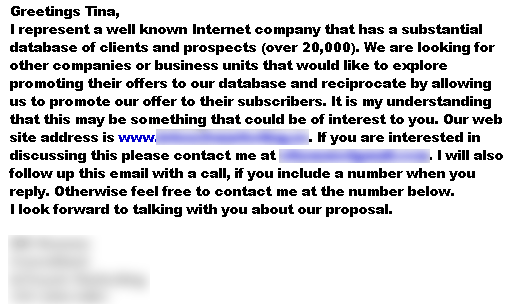
This morning, I received this little gem in my inbox (bold and everything):
Subject: We Are Looking For Offers For Our Database
My first instinctive reaction was “What the *bleep*?” I actually stopped reading the moment the email flashed open, because my eyes hurt from the brightness of the bold fonts. My follow up questions were: What do you need from me? What the heck are you selling? Why should I care?
After reading it about five times, I’m still left confused as to what they do, or what action items I can take - aside from giving up my phone number (which I would never do).
Reviewing our 15 tips above, a more effective email might be:
Subject: Opportunity for Free Traffic
Hi Tina,
I’m writing on behalf of
Our site gets X monthly page views, just having your website listed in our network will expose it to many new readers.
Here are some websites currently in our community:
- .Joining takes less than 5 minutes and you’ll love the results:
Let me know if you have any questions.
Take Home Points:
No rambling stories or long intros.
Get to the point quickly.
Next action clearly stated.
Present benefits.
Fonts and formatting matter.
Review for conciseness, simplicity and clarity.
One question per email.
Be yourself - that is, the concise version of yourself.
* What types of email annoy you, as a receiver? What tips do you have for keeping email efficient? Got ideas for writing ‘pitch’ emails? Share your thoughts and ideas in the comment section. See you there!
If you enjoyed this article, please vote for it on Digg, share it on StumbleUpon or bookmark it on del.icio.us. I appreciate your support. :)
Other Articles You May Enjoy:
Pen Zen: Bring Clarity to Writing
7 Hacks to Remember Any Name
Connect with Your Creative Writer
How to Delete Email Addiction
5 Keys to Simplifying Any Concept
4 Steps to Banish Email Clutter
External Resources on Concise Emails:
Mike Davidson: 5 Sentence Email Rule
Leo Babauta: 7 Rules for Clear and Concise Emails
Anne Zelenka: Why Emails Should be Short Instead of Nice
http://dandad.typepad.com/dandad/2008/09/introducing-hos.html
We're working with the team at ihaveanidea.org. They'll be running several events around North America for us this Autumn (Fall, if you're reading this on the other side of the Atlantic) and Hosan Lee, an American copywriter based in London will be coming along to our upcoming events and blogging her impressions and experiences on the IHAI blog. This is what Hosan has to say about herself:
"They say the average American goes through about 5 career changes in their lifetime. At the ripe old age of the 28-34 demographic, I've been through 4 – fashion, pr, journalism, law – and am now on my 5th. I've pursued 6 different academic disciplines formally: english literature, art history, film & media, environmental design, advertising design, and graphic design, as well as millions of other interests informally but seriously. I've lived in NJ, NYC, Baltimore, Philadelphia, and LA before moving to London to finish art school. Scandinavian music, bagels, Mexican films, tennis, International Klein Blue, fencing, the Coen Brothers, liquid laundry detergent pods, in my mind they're all connected. Life's an adventure, I love it all.And you know what all this feeds into? Advertising. I hope you'll enjoy my posts. I hope we'll have good conversations. And I hope we'll meet soon. Ciao!"