Whether personal or business, the ability to compose efficient and effective email is super useful - both in terms of productivity and responsiveness.
We’re all busy, and we’ve all received long, ambiguous and rambling email. Ironically, most of us have also been guilty of writing such verbose email while requesting for someone else’s time.
Now that I’ve had a little taste, on the receiving end of such email, it quickly became obvious which kind of email works and which do not. I have made some interesting and useful observations on effective email - particularly,
What not to do when emailing someone (ie. a stranger).
How to write email that people will actually (want to) read.
The point of this article is to share tips on how to approach people via email in the most efficient way possible, along with some common pitfalls on why some emails do not work.
Assumptions
Before we dive in, let’s lay out some assumptions:
The recipient (person you are emailing) potentially gets a lot of email
You need something from the recipient and plan on pitching it via email
You either do not know the recipient, or she is an acquaintance, or she is a close friend and you’re asking for an unusual request.
Our goal is to construct email that:
Will actually be read
Will actually be understood
Will not annoy the receiver
Does not take up too much time on the receiver’s end.
Email Psychology
Generally speaking, the sender and receiver see things from drastically different points of views. And from the perspective of a sender, we often do not spend time understanding who the receiver is and what their inbox might look like. Let’s have a quick glance at both sides:
Observing the Receiver
Gets a lot of email.
May receive compliments regularly, if they are a public figure.
Regularly gets asked a standard set of questions and favors.
Does not have a lot of free time.
Does not mind helping you, if it is fast.
Observing the Sender
Spends a long time crafting the ‘perfect’ (-ly long) email.
Believes that their request is original, unique, and special.
Believes that they are the first to ask for such favors.
Cannot imagine why anyone would turn them away.
Desires to tell the whole story, explained from every angle, so that the listener can understand their point of view.
With such divergent perspectives, it’s no wonder receivers receive the kinds of email that they do, and that senders are wondering why their emails isn’t effective or eagerly responded to.
We tend to answer, or be drawn to email that are the fastest to answer or process. That means email that require very little work or thought.
When we open an email that’s very long, our gut reaction is to close the email, or come back to it later when we might have more time.
When we receive an email from someone wanting something from us, wanting us to buy something, or wanting our time, we instantly feel guarded and will automatically want to say no, even if the offer will benefit us in reality.
We go through email while asking “what’s the point?”
We go through email that is pitching something while asking “why should I care?”
Most people know roughly what they want, but do not take the time to clearly think it through. This is how we end up with ambiguous or rambling email. Without a clear understanding of our desired end results, our thoughts are disorganized and we can easily confuse the receiver.
There are 4 types of email:
Self Fulfilling Email - The email itself is the point. You want to tell the receiver something, either a compliment or information. No reply is necessary.
Inquiries - You need something from the receiver in the form of a reply. For example, advice, or questions answered. The reply is your desired outcome.
Open-Ended Dialog - to keep communication lines open, for the purpose of some future result or benefit.
Action Emails - The goal is not the reply, but some action on the part of the receiver. For example, a sales pitch, or asking for a website link exchange.
Which type of email are you sending? What is your desired outcome?
The clearer your intention, the more focused you will be, the better you can cater email for the intended result, the more likely you will get your desired outcome.
2. Quickly Answers, “What’s the Point?”
People want to know “what do you need from me?” Answer this question quickly. Skip long introductions, backgrounds, compliments and details. Jump to the point. State it clearly using minimal words.
If action is needed, make it clear what the desired action is from the recipient.
And if no action or reply is expected, say that! “No reply necessary.” It’ll be like music to their ears.
3. State Benefits Clearly
If a pitch is presented, make sure it includes many clearly stated, easily understood benefits for the receiver.
Too many pitchy emails focus solely on the sender and why the action will benefit the sender. If you don’t present incentives, or they are difficult to understand, the receiver will say no - resulting in a waste of time for both.
Also, make sure the incentives are realistic, the exchange is fair, and there truly are benefits to the receiver. Do your homework before contacting someone. Put yourself in their shoes, “Would you act on the offer?”
Example, emailing a high profile website like lifehacker for a link exchange is not a fair exchange. It’s called spam. If they don’t display links to other sites, likely they won’t display yours.
4. Remember to KISS
KISS = Keep it simple, stupid (I didn’t come up with this)
When we send out a long email asking for something from the receiver (time, favor, etc), we are essentially saying “I do not respect your time.” Show them you appreciate their time, by making email short, and simple to answer.
Using as little words as possible, introduce who you are, context if necessary, and why you are emailing.
Being brief doesn’t mean we have to be boring. We can be creative with our wording, add a dash of personality where you see fit, but still be brief.
5. Save the Whole Story - Stick to the Facts.
People tend to say too much in email. We feel compelled to describe all the details and disclose the whole of our existence so that the receiver can understand the whole picture. Truth is, unless you already know this person well, they really don’t care.
Unless asked, you don’t need to overly elaborate anything. Simply stick to the facts - it’ll help you keep your message short.
6. Pretend Face-to-face Intro
If you just met someone new at a party, would you open your mouth first and give them a rambling story about your life? Probably not. Typically, we close our mouth after a quick intro. In email, stopping talking is equivalent to hitting the send button.
Treating email introductions as if you are meeting them in person is another trick to keeping messages short.
When we are on mobile devices like the blackberry or our cell phones, we lack the fluidity of the computer keyboard, and as such, we get to the point really fast.
Now, pretend you’re on a mobile device, what would your message be now?
8. Avoid Excessive Compliments
Some people have the idea that the more compliments they throw out, the more likely the receiver will comply with their offer/need/pitch.
There is a difference between being genuine and saying what’s on your heart, and going out of your way to compliment someone. We humans are exceptional at detecting unauthentic phrasings and remarks - even in email.
Compliment only if you really mean it. And remember to be brief if you need action from the receiver.
9. Be Personal and Personable
Personalize email with relevant remarks to the receiver, put in a quick comment about their site, product or work. Address the person by name, sign email with your own name, and a friendly comment like “Enjoy your weekend!”
10. Make it Easy to Be Found
In your signature, include appropriate URLs for your website, blog, portfolio or product. Make sure the links are functional so they can read more about you in one-click.
11. Use Simple English
When the writing is too formal or uses irrelevant technical lingo, it is difficult for laymen to understand. Plus, you come off sounding like a legal document or spammer. Neither is good.
Write like you talk, using conversational English. Be authentic and realistic.
Trying to sound professional will come off as if you are trying to sound professional. Use your real voice - it’s more endearing and approachable.
12. Font Matters
There is nothing worse than opening an email and become blinded by the brightness elicited by all the words displaying in bold. It makes me want to instantly close the email for the sake of protecting my eyes.
Alternatively, fonts that are too small, too large, or otherwise hard to read (ie. 8 point, times roman font, all bold.) makes us not want to read the email as well.
Beware of your fonts in your ‘presentation’. Do not bold the entire email, use easy to read fonts (ie. Arial), and use a standard size. Do not use extravagant colors since they don’t work well on all monitors and can be hard to read.
13. Formatting Matters
Make emails easy to read and quick to scan by using bullet points, numbered lists, and keeping paragraphs short. Highlight keywords (bold or italic) for emphasis, without over doing it.
14. Minimize Questions
Ask questions that matter, and limit the number of questions and favors you ask in an email (one or two max). The more questions (especially open-ended ones) asked in one sitting, the less likely you are to get a response, and the less likely all your questions will be answered.
Also, ask specific questions instead of a general open-ended ones. Be reasonable and thoughtful when asking. Don’t expect the recipient to solve all our life problems. For example, “How can I get rich quick? How can I become successful?” are too broad. Break them down into specifics and ask the one question that really matters.
You can send additional questions in separate emails. Key is in keeping the line of communication open by not overwhelming the receiver.
15. Trimming of Words
Like grooming a garden, read through the finished email and trim out words, sentences, and paragraphs that do not contribute towards your desired result.
Check for potential ambiguities and unclear thinking. Can you rephrase sentences for clarity using fewer words? Check for excess commentary that doesn’t add to the email’s main point. Remove extra details disclosed, unnecessarily.
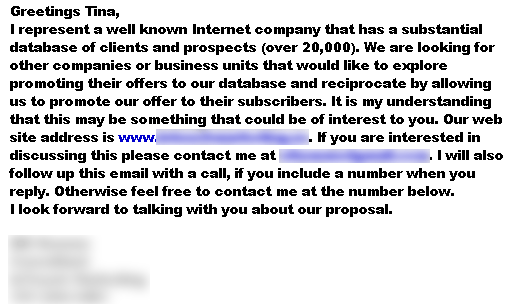
This morning, I received this little gem in my inbox (bold and everything):
Subject: We Are Looking For Offers For Our Database
My first instinctive reaction was “What the *bleep*?” I actually stopped reading the moment the email flashed open, because my eyes hurt from the brightness of the bold fonts. My follow up questions were: What do you need from me? What the heck are you selling? Why should I care?
After reading it about five times, I’m still left confused as to what they do, or what action items I can take - aside from giving up my phone number (which I would never do).
Reviewing our 15 tips above, a more effective email might be:
Subject: Opportunity for Free Traffic
Hi Tina,
I’m writing on behalf of
Our site gets X monthly page views, just having your website listed in our network will expose it to many new readers.
Here are some websites currently in our community:
- .Joining takes less than 5 minutes and you’ll love the results:
Let me know if you have any questions.
Take Home Points:
No rambling stories or long intros.
Get to the point quickly.
Next action clearly stated.
Present benefits.
Fonts and formatting matter.
Review for conciseness, simplicity and clarity.
One question per email.
Be yourself - that is, the concise version of yourself.
* What types of email annoy you, as a receiver? What tips do you have for keeping email efficient? Got ideas for writing ‘pitch’ emails? Share your thoughts and ideas in the comment section. See you there!
If you enjoyed this article, please vote for it on Digg, share it on StumbleUpon or bookmark it on del.icio.us. I appreciate your support. :)
Other Articles You May Enjoy:
Pen Zen: Bring Clarity to Writing
7 Hacks to Remember Any Name
Connect with Your Creative Writer
How to Delete Email Addiction
5 Keys to Simplifying Any Concept
4 Steps to Banish Email Clutter
External Resources on Concise Emails:
Mike Davidson: 5 Sentence Email Rule
Leo Babauta: 7 Rules for Clear and Concise Emails
Anne Zelenka: Why Emails Should be Short Instead of Nice
【本文選自眾文圖書之《美國老師教你寫出好英文》】
Often overlooked, this step can make your writing smoother, clearer, and shorter. Just as the rails of a train track must be parallel, try to make your structures parallel by expressing similar ideas in a sentence with similar grammatical forms.
此步驟經常被忽略,但它可以讓你的寫作更加流暢、清楚和簡短。就像火車的軌道必須平行,你也可使用文法形式近似的句子來表達類似的想法,讓你的結構也能夠平行。
Which sentence is clearer?
哪個句子比較清楚?
A. Taipei is very large; it has lots of people, and I find Taipei fascinating.
B. Taipei is large, crowded, and fascinating.
“B” is better, clearer, and less cluttered. Why? Large, crowded, and fascinating are all adjectives, in parallel structure.
B句較佳,它比較清楚和精簡。為什麼呢?因為large, crowded, fascinating都是形容詞,形成平行的結構。
Here are some easy tips to remember. →For each set, the first sentence is not parallel, while the second one is.)
以下是一些平行結構的簡單訣竅。(每組的第一個句子不是平行的,第二句才是。)
1.Make adjectives parallel.使形容詞平行
●The large dog snarled loudly and scared us.
→ The large, scary dog snarled at us.
2. Make nouns parallel. 使名詞平行
●Please bring charcoal, a box of matches, some meat dishes, and some kind of vegetable to the picnic. And we will need something to drink too.
→ Please bring charcoal, matches, meat, vegetables, and drinks to the picnic.
3. Make verbs parallel. 使動詞平行
●Victor, smiling, said “hello,” then quickly bounded away.
→ Victor smiled, said “hello,” then bounded away.
(Notice the parallel verbs are all in the past tense.)
(所有動詞在平行結構中皆為過去式。)
●My morning routine, after waking up, is to have some breakfast, and after having brushed my teeth, I try to leave home by 7:00.
→My morning routine is to wake up, eat breakfast, brush my teeth, and leave home by 7:00.
(These parallel verbs are all in the present tense.)
(所有動詞在平行結構中皆為現在式。)
4. Make adverbs parallel. 使副詞平行
●He drove the car with great care and also safely.
●He drove the car carefully and safely.
5. Make phrases, clauses, and comparisons parallel. 使片語、子句和比較平行
●Deborah is good with art as well as in the area of music.
→Deborah is good with art as well as with music.
Here is an example from technical English, reporting on robot technology.
以下是科技英文的例句,報導機器人技術。
●Recently, this technology has been gradually adopted in industry, medical purposes, business and family applications.
→Recently, this technology has been gradually adopted in industrial, medical, business, and family applications.
→Make “industrial” an adjective and cut “purposes.”)
(用形容詞industrial,並刪除purposes。)
【本文選自眾文圖書之《美國老師教你寫出好英文》】
Nouns are like the building blocks of your writing. Just as your home would crumble if it were built of poor bricks, so too nouns can make or break your writing.
名詞好比是寫作中的建材,就像房屋若用劣質的磚頭建造就會崩塌,而名詞也一樣會讓你的作品堅實或是塌陷。
This is where a good vocabulary comes in. Think of one strong noun that can do the work of two or three weaklings.
好的詞彙用法就是以一個強有力的名詞來取代兩三個虛浮的字眼。
The small child wobbled. → The toddler wobbled.
Robert is an extremely smart boy. → Robert is a genius.
Myrtle was such a godly woman. → Myrtle was a saint.
Billy, your paper is a true work of art! → Billy, your paper is a masterpiece!
Fincastle, Virginia is a quaint little town. → Fincastle, Virginia is a quaint hamlet.
Maybe you have noticed by now, and I do not want to sound too violent, but part of your job is to kill adjectives. In other words, replace an adjective (or two) and a weak noun with one strong,
specific noun, i.e.:
你可能已經注意到,而且我實在不想形容得過於暴力,但寫作時有一部分的工作就是要消滅形容詞。換句話說,就是要用一個強有力的特定名詞來取代形容詞和虛空的名詞。例如:
Rebecca ordered a prime steak. → Rebecca ordered a rib-eye.
He drove an expensive sports car. → He drove a Jaguar.
Turn right at the small, wooden house. → Turn right at the cabin.
Wow, that girl is really pretty! → Wow, that girl is a beauty!
The storm was very destructive. → The storm was a nightmare.
Thanks for the dinner. It was really delicious. → Thanks for the dinner; it was a treat.
She carried an expensive designer bag. → She carried a Gucci bag.
As you cut adjectives, try especially to get rid of weak adjectives like good, bad, nice, etc.
刪除形容詞時,特別要去除掉虛浮的形容詞例如good, bad, nice等字。
Employ Vivid Verbs 使用生動的動詞
If nouns are the building blocks of writing, verbs are the jet fuel because they propel your language. And as with nouns, avoid the common, dull verbs when you can; instead, employ vivid, colorful ones. In particular, cut be verbs (am, is, was, will be, etc.) when possible.
若把名詞喻為寫作的建材,那動詞就是噴射機的燃油,因為動詞可以驅動你的文字。而與使用名詞一樣,儘量避免使用平淡無奇的動詞,而改用生動富有色彩的動詞。特別盡可能少用be動詞(如am, is, was, will be等)。
Emily was nervous before the interview. → Emily trembled and bit her nails before the interview.
The car came to a halt. → The car screeched to a halt.
“Are we there yet?” Meghan asked. → “Are we there yet?” Meghan whined.
The lawnmower made noises and stopped running. → The lawnmower sputtered and died.
“I hate this!” she said unthinkingly. → “I hate this!” she blurted out.
Robbie walked quickly up the stairs to see his date. → Robbie sprinted up the stairs to see his date.
Verbs not only make your sentences stronger, but they tell the reader of the action. Look at how different verbs change the whole tone of these sentences.
動詞不僅讓你的句子更有力,也能告訴讀者文章中的動作。看看以下的句子,不同的動詞如何改變整句的語氣。
●The soldiers went up the mountain.
Boring, right? And we do not know how or why the soldiers “went up the mountain.”
以上的句子很乏味,而且我們也不知道士兵為何以及如何went up the mountain。Now, have a look:
再看看下面的句子:
1. The soldiers trudged up the mountain.
2. The soldiers clawed their way up the mountain.
3. The soldiers inched their way up the mountain.
4. The soldiers fought their way up the mountain.
5. The soldiers charged up the mountain.
6. The soldiers advanced up the mountain.
Note how each sentence is different, depending on the verb. Numbers 1-4 imply the soldiers worked hard to climb the mountain, slowly, while 5 shows they moved quickly, and 6 is more vague.
因為使用不同的動詞,使每個句子的意義都不一樣。第一到第四句的動詞意謂士兵上山的過程既艱苦又漫長,第五句就感覺行動快多了,而第六句的意義則比較模糊。
http://mag.udn.com/mag/campus/storypage.jsp?f_MAIN_ID=381&f_SUB_ID=2705&f_ART_ID=157549